The Allure of Fascism (Vol. II), Part 19
The Trump administration is undeniably illiberal and authoritarian. Officials have repeatedly telegraphed their contempt for the law and democracy. All branches of the government have collaborated to extend executive power, allowing Trump to present himself as a messianic, dictatorial figure. The state is abusing its powers of policing, surveillance, and counter-terrorism to enact a racist, anti-migrant deportation programme, and to criminalise leftist political movements.
Clearly, MAGA is not a liberal political movement. But that does not mean that they are unambiguously “fascist.” As Dylan Riley suggested, there are some individuals within the administration like Stephen Miller who one can easily describe as fascist. Doing so is not so simple for others like JD Vance. Some of the administration’s key collaborators—namely, Silicon Valley tech radicals like Peter Thiel, who espouse an anti-nationalist, libertarian doctrine—are not exactly fascist either.
On an ideological level, Trump’s administration does not articulate a unified intellectual or ideological framework that underwrites or justifies its actions. Some elements can be neatly categorised as fascistic. Pursuing national revitalisation (‘Make America Great Again’) with the help of and for the benefit of the capitalist oligarchy (Silicon Valley CEOs and fossil fuel executives) by demonising, imprisoning, and/or expelling internal enemies (racialised migrants, leftists and antifascists, pro-Palestine protestors, trans people, etc. who are classified as terrorists) who are persecuted and surveilled by a politicised and militarised police force (ICE), while undermining democratic and legal institutions at home, suppressing free speech, concentrating dictatorial power in the executive’s hands, and engaging in imperialistic exercises abroad (Venezuela) via genocidal threats (Iran), all sustained by fantasies of rebirth and decay, death or decline, and messianic authority (Trump’s self-depictions as Jesus or a monarch)—these features of Trump’s second administration fit easily into the category of fascism.
Other elements, however, like the Trump family’s flagrant schemes for self-enrichment (Trumpcoin, the president’s enormous number of stock trades), and DOGE’s mission to destroy government institutions and fire large numbers of federal employees, do not align with fascism classically conceived, but with other forms of right-wing kleptocratic, oligarchic capitalist, and/or authoritarian government. Indeed, as commentators from Wendy Brown to Slavoj Žižek have argued, some of these elements are better viewed as radicalisations of the neoliberal political and economic agenda that defined bipartisan politics in the US after Reagan. Others like Yanis Varoufakis argue that these hard-right political movements have in fact emerged alongside a fundamental transformation of our core economic logic: we no longer live under capitalism, he argues, but something else, a kind of “techno-feudalism” defined by the tight alliance between central banks, financial institutions, and surveillance-tech companies. Whatever we call the new far-right, this view suggests, it operates not on behalf of capitalism but on behalf of an entirely new economic formation. Fascism may therefore be an inadequate label for contemporary politics.
Beyond this, it is also clear that the political logic of Trumpism, however we describe it, has not wholly captured the American state or its populace. Despite his second administration’s successes, public mass resistance both exists and remains possible. The unbelievable momentum of the administration’s first months has also declined. Distracted by the Iran war, Trump’s administration now appears to be faltering. The success of their agenda, which once seemed almost inevitable, now seems to be slipping out of their reach. We can only hope that their own ineffectiveness will lead them to fail.
Trump’s second administration is at least partly animated by fascist desires and intentions. Some of its desires are not precisely fascist, however, and it has not yet achieved a full fascistisation of either the government or American society. In other words, Trump’s second administration is ante-fascist: it is moving towards the extreme of fascism, but it has not yet arrived.
MAGA’s fascism also differs in important respects from classical fascism. From its inception, Trumpism has lacked a rigorously defined ideology. The movement’s appeal has always been rooted in affect, image, and fantasy more than ideology or programme. The pursuit of those feelings and desires, though, has led the movement to engage increasingly in a politics that can be described as fascistic. MAGA’s movement towards fascism has occurred in a less coordinated, planned, or centralised manner than fascisms past. Unlike earlier fascist movements, which made a point of explicitly articulating and defining their ideological and intellectual frameworks, contemporary fascism is emerging in a more anarchic and contingent fashion. To use an economic metaphor, MAGA’s movement towards fascism is less centrally planned than it is laissez-faire. Rather than defining fascism as an ideology with a specific set of goals and working deliberately towards them, MAGA has become increasingly fascist in a more organic fashion, radicalising itself from within. Through the movement’s years of success and failure, elements that were always present (its authoritarian, violent and undemocratic nature, or its racism, anti-leftism, misogyny, and anti-migrant attitudes) have become more prominent. These elements are gradually congealing into something more fully fascist, even if fascism itself has not been explicitly posited as the movement’s ultimate goal or fundamental logic. It is partly for this reason that MAGA still denies that it is fascistic, despite the clear parallels between their politics and past movements.
MAGA’s fascism is emerging more from the interaction between its underlying impulses and its ongoing processes than from any explicitly articulated ideological commitments. This suggests that explicit ideology and self-definition are not necessarily the most important elements in defining fascist political movements. As Robert O. Paxton argues in The Anatomy of Fascism, a political movement is perhaps better defined by examining its actions, behaviours, processes, impulses, rhetoric, images, and symbolism than by accepting its own self-description. A movement can be fascist at the level of desire—indeed, unconscious desire—even if it consciously believes itself to be a liberal, democratic movement, dedicated to preserving society and its norms. Though MAGA insists that it will “save” and revive America, then, the movement very clearly desires a creative destruction of the country. Viewing its actions and statements holistically, it appears that MAGA’s utmost hope is to destroy America’s current institutional framework and create an undemocratic, authoritarian police/surveillance state ruled by a messianic dictator, which features a close alliance between corporations, state, and church, that preserves private property and heightens inequality, and criminalises leftist and antifascist movements. MAGA yearns for a world where white, heterosexual men dominate women and minority groups, where the “enemies within” are defined as “terrorists” and imprisoned or deported and the “enemies outside” are imperialistically controlled, defeated in war, or otherwise thwarted, where the universities and media comply to suppress criticism and dissent, and where dreams of nationalistic rebirth are achieved and “othered” groups are banished or eliminated.
In 2026, MAGA’s desires are often fascist. Disavowing the true sources of their discontent, they yearn to conduct a full-scale War on Terror against the American people. Whether they will satisfy those desires remains an open question. As this conclusion is published, only a few weeks before the US mid-terms, it is unclear if the Trumpist “revolution,” to use Kevin Roberts’ term, will succeed or fail. We don’t know if it will descend into a nightmarish bloodbath and achieve the fullest expression possible of its murderous logic, or, facing insurmountable frustration, find itself diverted, mired, and stuck in the transitional space of ante-fascism. All depends on the strength of their movement—and, more importantly, the strength of our opposition.
In this sense, the question of whether Trump, Trumpism, and his second administration are fascist, is ultimately secondary. The primary question is: knowing all they have done and said, all they believe, and all they plan to do, should we accept their desires as our political present and future? For anyone who values peace, stability, and moral integrity, who abhors domination, violence, repression, and subjugation, and who desires a politics grounded in material reality instead of vicious paranoid delusion, we must answer in the negative. Knowing what we know, we must resist and create friction that inhibits or prevents them from actualising their terrible fantasies. We must work towards something other—something better than the contemptible, farcical, stupid, and violent politics that defines Trump and his followers.
We are now at the end of this series of essays. This writing project has tried to create an emotional history of America, a history of its fascistic desires. Spanning decades of national and international history, the analysis presented is necessarily partial and incomplete. What it has tried to convey, however, is that this fascistic desire has emerged anarchically and contingently out of the interaction between America’s long-held ideals and the series of failures and crises created by its attempt to secure its hegemony through economic, political, and military means. Today’s fascism, it has suggested, is in many ways a mutation and extension of the logics that have underwritten America’s Long War on Terror. This war, which began during the Cold War before being radicalised in the early 21st century, has entered a terminal phase. Rather than address the true sources of today’s discontent, its perpetrators now aim their violence at the American people. At themselves. This suicidal turning of the war back against the country itself is a sign of its failure. Unable to win the war against the terror within, the chronic fear generated by our global systems over their decades of crisis, they have opted for a barbarism that seeks domination and security, but whose end result can only be self-annihilation. Suicide through destructive self-consolidation—this is the wish at the very heart of fascism.
A desire for fascism is the logical but not inevitable product of decades of American mismanagement and failure, and its continued attachment to the racist, patriarchal, and capitalist structures of domination and exploitation that have long defined the country. It is a product of the population’s “infinite discontent”: the endless anguish of a people subjected to racial capitalism, renewed and deepened with each crisis. Ultimately, it is this discontent that has led the population of the United States and its leaders to desire fascism—to want a political programme devoted to domination, destruction, and death.
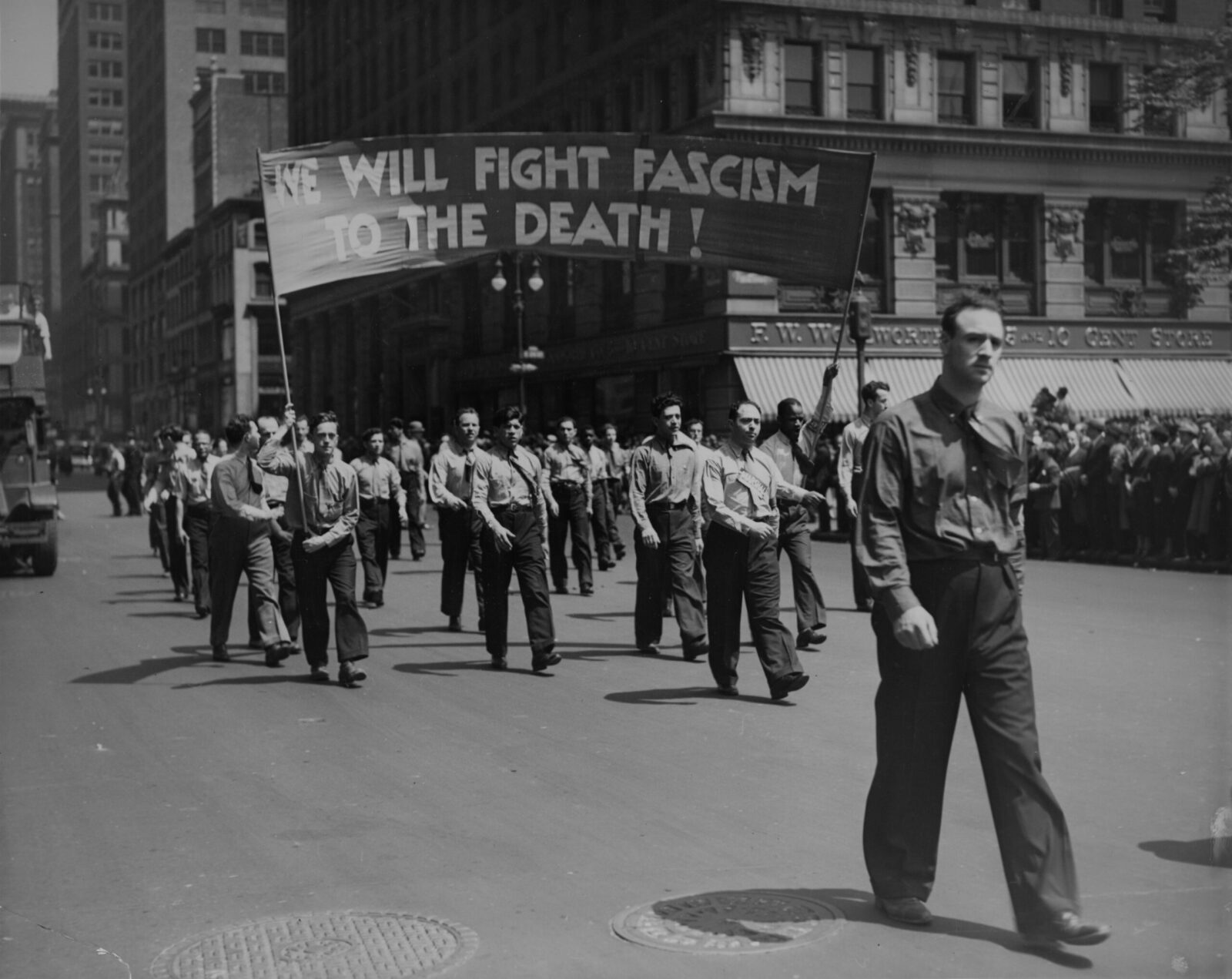
Anti-fascist politics today must work to address this furious, destructive desire if it hopes to avert disaster. We must do all we can to reduce the allure of fascism. To do so, we must take power away from the far right and redistribute it among people who wish to build a different, safer world—one where the mass desire for fascism is overwhelmed by the existence of a better and more inclusive reality. Discovering our desire for that antifascist reality—its content, and its forcefulness—and the strategies we can use to create it is our most important task today.